Google Ad Grants, paid Search and Meta, awareness-month and walk campaigns, accessible donation flows, email automation. One senior team for a five-person communications department, measured on the numbers your board asks about.
Most neuro and health nonprofits we talk to have a communications team of three to five people running email, social, the website, the Ad Grant and two event seasons a year. The work gets done. What rarely gets done is the measurement that tells the board which of it mattered.
Ad Grant suspended or under-used. Below 5% click-through for two months, Quality Score 1–2 keywords left running, no conversion tracking. The $10,000 quietly goes unspent.
Donation page loses mobile donors. Half of visits are on phones; a small nonprofit converts 4% of them. Every awareness-month spike leaks out the same hole.
First-time donors never give twice. Roughly one in five first-time donors returns. Nothing automated reaches them between the thank-you and next December.
Reporting counts the wrong things. "All conversions" inflated by page views and directions clicks. Boards get numbers that do not match the bank.
Organic traffic is sliding. AI overviews answer the question before the family ever reaches your resource page. Without an answer-engine strategy, that decline continues.
Take one or all six. Every engagement starts with tracking that counts real actions: donations, sign-ups, registrations, calls. Not clicks.
Activation if you never claimed it, rescue if it was suspended, and monthly management that keeps it compliant: CTR above 5%, low-quality keywords paused, conversions tracked. Campaigns built around the searches your community makes: symptoms, second opinions, support groups, clinical trials, your walk.
Paid Search is the one channel that reliably returns more than it costs for nonprofit fundraising. Meta is where supporter lists grow. We run both with the same discipline we use on €1M+ of managed spend: exact-match structure, negative lists, bid toward real gifts.
Your year has peaks: the awareness month, the walk or ride, Giving Tuesday, December. We build the landing page, the ad set, the email run and the short-form video for each one, then reuse the engine next year with last year's data in it.
A productised rebuild scoped the way your RFPs already read: CMS you can edit, WCAG 2.1 AA from the first wireframe, mobile donation flow with Apple Pay, Google Pay and PayPal, integration with Blackbaud, Bloomerang, Neon, Fundraise Up or Givebutter, GA4 and conversion tracking, staff training, documentation and a post-launch support plan. Content structured so AI answer engines cite you.
Welcome series, post-gift impact update, lapsed-donor reactivation, monthly-giving upgrade, year-end sequence. Built in the tool you already have, fed by the ads and the website, so a first-time December donor hears from you in February without anyone remembering to write.
Short-form for the awareness month and the walk, one anchor piece a year for the appeal and the annual report. Donors say they want real people over polish; we cut for that. 500+ videos and 150M+ views across creator and brand accounts.
Grant audit and rescue, tracking rebuild, donation-flow fixes before the first peak. Email flows live.
Parkinson's (Apr), brain tumor (May), Alzheimer's and brain awareness (Jun). Walk and ride season. Campaign engines run.
Website rebuild window. Paid Search and Meta list growth so December has an audience. Impact video shot.
Epilepsy awareness (Nov), Giving Tuesday, year-end. About a third of online giving lands here; everything above was built for it.
One page, within five business days, no obligation. Send us your organisation name and website; we do the rest from public data and, if you already have a grant, read-only access to your Google Ads account.
We are in Berlin, which means your account is watched while your team sleeps and US mornings are our afternoons. Calls happen in US Eastern time.
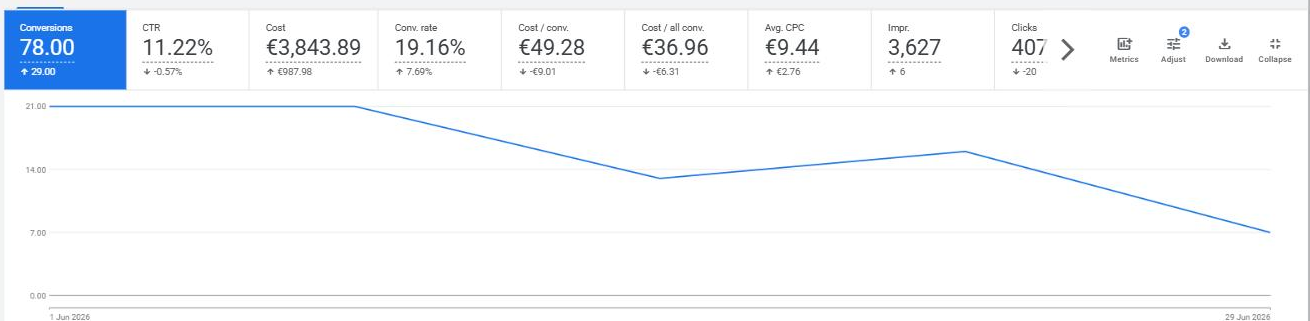
Our track record is in service businesses where every enquiry has a price. The measurement habit transfers: these are anonymised Google Ads scorecards, numbers untouched, counting only form fills and calls.
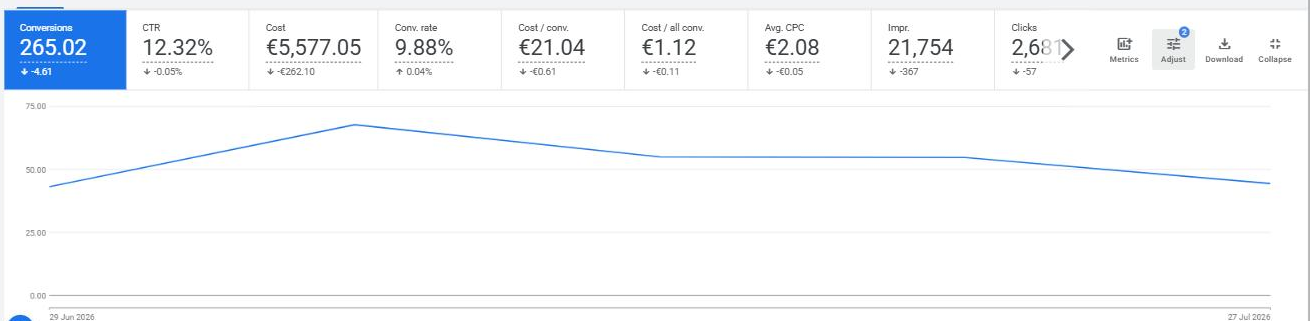
We publish only screenshot-backed results. Our first nonprofit case studies will appear here as they complete; until then we would rather show you real numbers from another sector than invented ones from yours. The full proof section is on the main site.
Google Ad Grants gives eligible 501(c)(3)s up to $10,000 a month in Google Search ads at no cost. It is a reach tool: across the sector it brings about 229 site visits per $1,000 of grant budget but very little direct donation revenue. We use it for patients, families, volunteers, event registrations and email sign-ups, and we use paid Search, which returns about $2.48 per $1, for fundraising.
Grant status and risk, budget actually used, conversion integrity, the searches you are missing, your mobile donation flow and accessibility exposure, and one recommendation. One page within five business days. No obligation.
Flat monthly fees for management work and fixed project prices for website builds, scoped on the call. We do not charge a percentage of the Ad Grant, because the grant is not your money. Ad spend on paid channels is paid directly to the platforms.
Yes. We build around what you have: Blackbaud, Bloomerang, Neon One, Bonterra, Salesforce NPSP, HubSpot, Fundraise Up, Givebutter, Donorbox, Classy, Mailchimp, Constant Contact. Replacing a platform is a recommendation we make only when the data says so.
On the actions you already report to your board: donations, registrations, sign-ups, calls. Never on page views, directions clicks or "all conversions". You see the same Google Ads and GA4 dashboards we see, and you own every account.
Most of our work is already across time zones. Your account is monitored during US night hours; calls are held in US Eastern time; everything is in English. Being outside the US also means we are not competing with you for the same donors.
We work with aggregate campaign data and conversion events, not patient records. Tracking is configured with consent handling and without health details in URLs or ad platforms. Our background is GDPR-compliant tracking in Germany, which is stricter than most US requirements.
Five business days, one page, no pitch deck. If there is nothing to fix, we tell you that too.
We use only essential cookies by default. With your consent we also use analytics and advertising cookies to measure traffic and campaigns — see our Privacy Policy.